Important: All content on this page is drawn from filed court documents. These are allegations by the Applicants. They do not constitute findings of misconduct. Lord Justice Nugee is entitled to the presumption of having acted in good faith.
Lord Justice Nugee sat as part of the Court of Appeal constitution in CA-2025-001529, CA-2025-001746 and CA-2025-001861, together with Lady Justice Andrews. The Applicants allege that the constitution did not review the lower court's process — it adopted and extended it, supplying new factual premises that HNW had never advanced, treating non-determinations as determinations, and refusing protective relief against continuing alleged illegal evictions while describing the harm as "difficult to see."
The Applicants do not need to prove conscious racial animus for the concern to be constitutionally serious. The question is objective. A fair-minded and informed observer would ask why, across repeated courts and tribunals, a represented corporate lender received correction, indulgence, assumption and enforcement, while Black litigants received disbelief, evidential foreclosure, missing transcripts, refusal of protection, and ultimately a threatened Civil Restraint Order. That is the appearance of unequal protection. It is precisely the kind of institutional pattern that undermines confidence in civil justice even where no individual decision-maker admits or recognises bias. The same pattern repeated across courts and tribunals. It is not isolated error.
The departures attributed specifically to Lord Justice Nugee, or shared with Lady Justice Andrews as co-members of the same constitution, are set out below. All are drawn from the Applicants' filed documents. None constitutes a finding of misconduct. The open letter to the Lord Chancellor dated May 2026 addresses these matters at institutional level. Read the Open Letter ↗
Premature fraud finding — "Not persuaded of fraud" without any evidential route
The Applicants allege that Lord Justice Nugee stated the Court was "not persuaded there has been any fraud" without disclosure, metadata, native files, cross-examination, expert testing or trial having occurred — treating the absence of completed proof, caused by the refusal of the proof-route, as proof of absence.
Independent forensic evidence from Keith Borer Consultants / Caramiello showed that the signatures on pages 25 and 28 of the two versions of the loan agreement were pixel-identical — consistent with digital copying rather than separate signings. That evidence was never put to trial, never the subject of expert cross-examination, and never tested against the native files and metadata that disclosure would have produced. Disclosure of the execution trail was refused. The Applicants say that once the route to proof was removed, the resulting absence of completed proof was then used to conclude there was no fraud. That inverts the proper sequence under Takhar v Gracefield and the Mercury Tax Group composite-document principle.
The forensic evidence: The image below, drawn from the filed Expert Report, shows the signatures on both agreement versions overlaid. The pixel-identical match is consistent with one signature having been digitally copied onto a document with materially different terms.
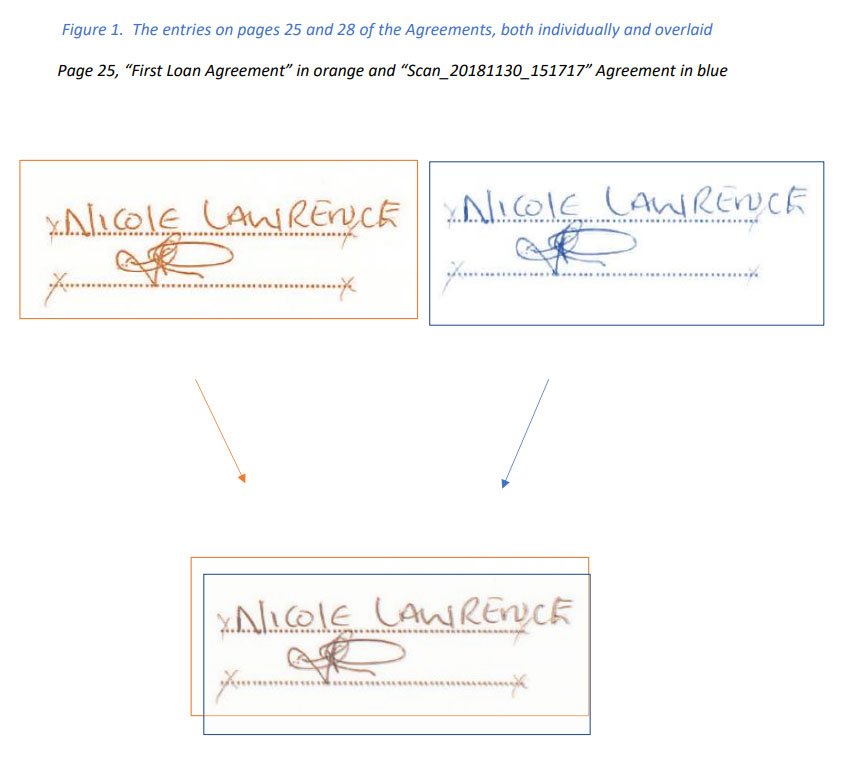
Signature overlay from the Keith Borer / Caramiello Expert Report. Pages 25 and 28 of the two agreements: the signatures are pixel-identical, consistent with digital copying. This evidence was never tested at trial. View full Expert Report ↗
Descent into the arena — Inventing the escrow-delivery chronology
The Applicants allege that Lord Justice Nugee (together with Lady Justice Andrews) did not merely adopt HNW's pleaded case — the constitution supplied a factual premise that HNW had never advanced and that was directly contradicted by HNW's own verified pleading and the stamped documentary receipt.
HNW's pleaded and verified case was that the legal charges were held on 14 November 2018 — confirming escrow transmission. A stamped receipt in the documentary record confirmed that holding. The Court's judgment recorded that the charges were provided "directly after completion" — a chronology HNW had not advanced, which the Applicants say was invented by the constitution. That single invented phrase supplied the missing factual bridge that avoided the escrow problem entirely: if the charges moved "directly after completion" there is no gap, no held instrument, and no escrow-release step requiring explanation.
The Applicants say that is not neutral fact-finding. It is descent into the arena: the constitution supplied the missing proof-route for the represented corporate claimant while the unrepresented Black family lost their properties. The unsupported premise operated entirely in HNW's favour and entirely against the Applicants.
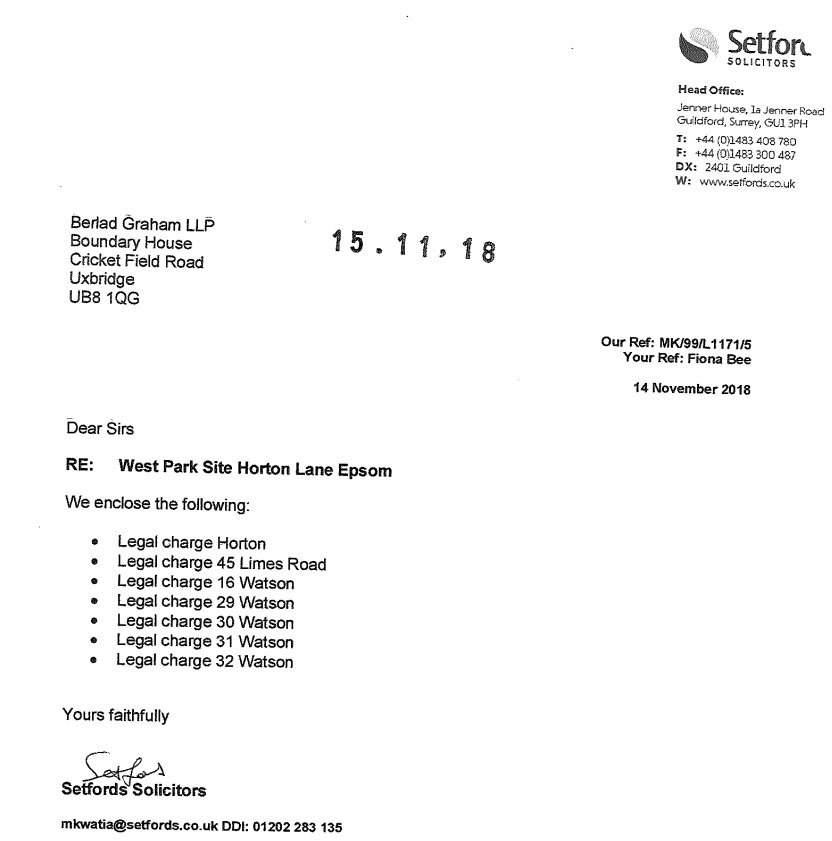
Stamped receipt exhibited in proceedings: legal charges held on 14 November 2018 — directly contradicting the invented "directly after completion" chronology. Filed as Greene v HNW Précis.
Factual errors maintained after specific identification and documentation
The Applicants allege that when documented factual errors in the chronology relied upon by the constitution were specifically identified and placed before the Court, Lord Justice Nugee maintained a position that cannot be reconciled with the documentary record. Clear factual errors were allowed to stand. The corrective mechanism existed in form but was disabled in substance when invoked by these Applicants.
The CPR 52.30 mechanism exists precisely to correct process-integrity failures of this kind. The Applicants placed before the Court a documented record of the specific errors — including the invented "directly after completion" chronology, irreconcilable with the stamped receipt and with HNW's own verified pleading. Rather than correcting those errors, the same constitution whose reasoning was directly impugned maintained its position. The Applicants say that is a structural breach of the principle in UCP Plc v Nectrus: a process-integrity challenge must not be determined by the constitution under challenge.
Unequal credibility treatment — HNW saved by inference; Black litigants' fraud case closed without safeguards
The Applicants allege a repeated and directional pattern throughout the proceedings: HNW's position was treated as capable of being saved by inference, reformulation and judicially supplied chronology, while the Black litigants' documentary fraud case was treated as answered without any of the safeguards required to test it.
At first instance, Lenon KC rewrote HNW's pleaded case — softening the forgery question and reducing HNW's evidential burden — while simultaneously hardening Ms Lawrence's fraud case into "insubstantiality" before disclosure or trial. The Applicants allege Lord Justice Nugee and Lady Justice Andrews then repeated that same process failure on appeal: they adopted and extended the reformulated case, supplied new premises HNW had not advanced, and treated the fraud allegation as answered while denying the alleging party the tools by which fraud is proved or disproved.
"Difficult to see the harm" — Refusing protection against alleged illegal evictions
The Applicants allege that Lord Justice Nugee (with Lady Justice Andrews) refused interim protective relief against continuing illegal evictions, board-ups, smashed windows, displacement and harassment, stating that it was "difficult to see the harm." Since that refusal, the Applicants say the harm escalated materially.
Ms Lawrence and Mr Greene placed before the Court evidence of repeated forced entries without any court order, the smashing of windows, boarding of properties, displacement of occupiers including children, removal of possessions and documents, and continued harassment. No court order, warrant, notice or identified statutory power was produced for any of those entries. The Protection from Eviction Act 1977 makes residential eviction without a court order a criminal offence. The Applicants say the Court's refusal treated documented, photographed, continuing harm as legally invisible — and thereby enabled its continuation.
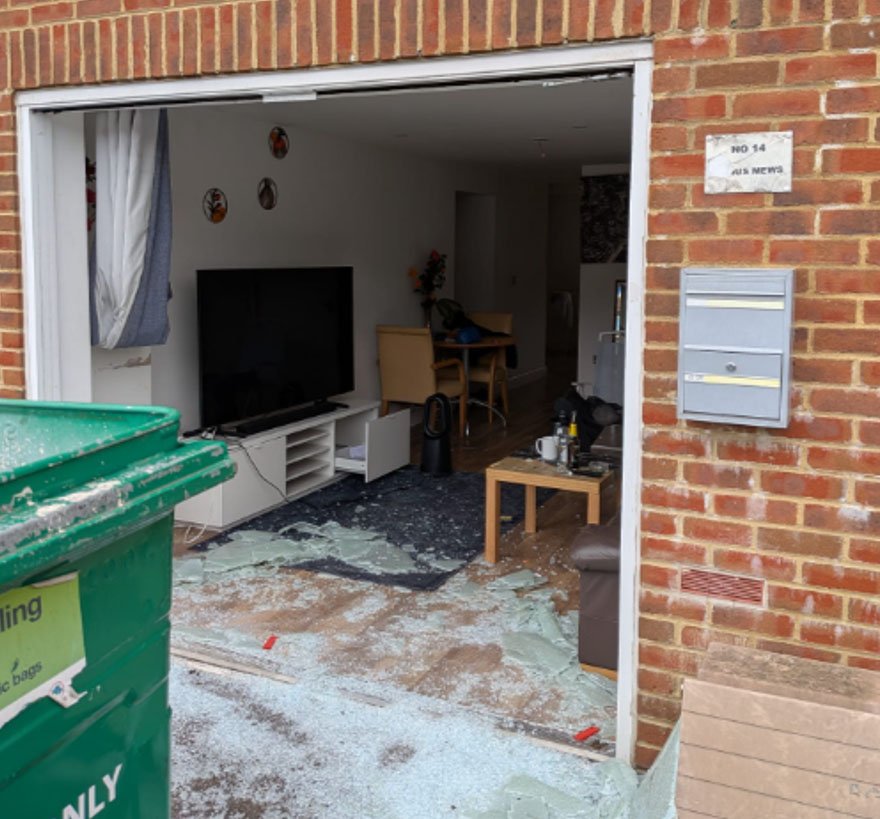
Photograph exhibited in proceedings: smashed windows and forced entry at an occupied property — alleged to have occurred without any court order or identified statutory power.
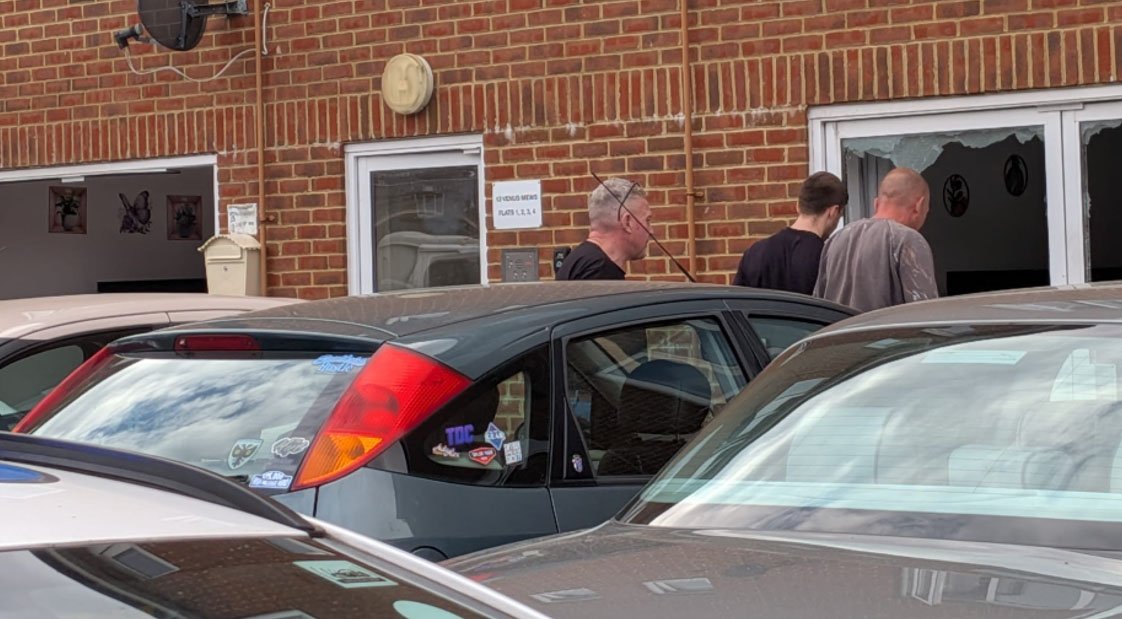
Further damage photograph: boarding of occupied premises. Part of a continuing pattern from January 2021 to April 2026.

Enforcement officers attending a property without identified court order or writ — filed as evidence of unlawful eviction.
The appellate court's role — Adoption and extension rather than review
The Applicants allege that Lord Justice Nugee did not perform the review function that an appellate court is required to perform under CPR 52.21. Instead of scrutinising the lower court's process, the constitution adopted and extended its premises — supplying new dispositive conclusions that went beyond even what HNW had pleaded — and thereby compounded the same process failures that were the subject of the appeal.
The proper appellate function is to determine whether the decision under appeal was wrong or unjust because of a serious procedural or other irregularity. Where the challenge is to process integrity — to the fairness of the adjudicative platform itself — the appellate court must examine whether the required safeguards operated. The Applicants allege the constitution instead:
- Adopted Lenon KC's reformulated chronology and treated it as settled
- Supplied new premises absent from HNW's pleaded case: "directly after completion," "monies undoubtedly advanced," "adoption," "ratification," "no fraud," "no harm"
- Treated non-determinations at first instance as determinations
- Refused protective relief designed to prevent the hardening of precisely the consequences under appeal
- Maintained factual errors after those errors were specifically documented and placed before the Court
The Applicants submit that the departures above are not isolated errors. Together with the departures attributed to Lady Justice Andrews, they form a coherent mechanism: a corporate claimant's case was reformulated and bridged by judicial reasoning; a Black family's fraud case was rejected without the tools needed to prove it; property was lost without trial; illegal evictions were minimised and described as producing no visible harm; beneficial interests were extinguished by procedural closure; a CPR 52.30 application was refused by the constitution under challenge; and a Civil Restraint Order was threatened to prevent further correction.
The unanswered question is how that sequence can be reconciled with fair and neutral adjudication. If fraud was rejected without disclosure, metadata, native files, expert testing or cross-examination; if independent expert evidence was dismissed without counter-evidence; if escrow delivery was invented by the Court without a release act; if document provenance was never tested; if evidence destruction was not investigated; and if courts and tribunals then treated those non-determinations as determinations — the concern is not merely error. It is institutional failure in operation. On the Applicants' case, the proof-routes were removed, the legal tests were inverted, the document-testing route was withheld, and the resulting evidential gap was used to close the case. That does not resemble a neutral referee deciding a proved dispute. It resembles a manufactured endpoint: the appearance of being heard converted into actual exclusion.
The public question for BAME communities is stark: why should they trust orders that carry judicial form but lack lawful adjudicative substance, and why are they not entitled in practice to the same protection from fraud, forgery, unlawful eviction, proof destruction and procedural unfairness that the law promises on paper? This is the subject of a formal open letter to the Lord Chancellor dated May 2026.