Important: All content on this page is drawn from filed court documents. These are allegations by the Applicants. They do not constitute findings of misconduct. HHJ Lenon KC is entitled to the presumption of having acted in good faith.
The judgment of Andrew Lenon KC dated 17 April 2025, and the consequential order of 19 June 2025, are the subject of a set-aside application filed by Nicole Lawrence on 8 April 2026 (N244, Claim No. PT-2024-000012). That application rests on four Schedules: (A) False Platform / Procurement; (B) Core Integrity Issues Left Untried; (C) Legal Departures / Procedural Unfairness; (D) Consequential Contamination / Downstream Reliance. A witness statement verified by Statement of Truth supports the application.
The nine alleged departures set out below are drawn from those filed documents. The Applicants' case is that the departures were not isolated errors but a structural sequence: a corporate claimant's case was judicially softened and reformulated at every evidential weakness, while a Black family's fraud and forgery case was shut out without the safeguards by which fraud is proved or disproved. That sequence is characterised in the filed documents as a pattern of unequal procedural protection with racially significant effects. The Applicants do not allege subjective racial motive; they rely on objective, effects-based unequal treatment engaging Article 14 ECHR read with Article 6 and Article 1 Protocol 1.
Reformulation of HNW's pleaded case — descent into the arena
The Applicants allege that HHJ Lenon KC rewrote HNW's pleaded and verified positive-signature case into an unpleaded adoption/delivery/ratification route, thereby removing the fraud and forgery question without requiring HNW to plead the new route, giving the Applicants an opportunity to respond to it, or supplying the disclosure, expert evidence and cross-examination needed to examine it.
HNW's pleaded case, repeated across its Reply and Defence to Counterclaim at paragraphs 12, 62 and 64, was unequivocal: "it is the Claimant's case that the Defendant did sign the Loan Agreement." That positive-signature case created a binary: either Ms Lawrence signed the manuscript-amended £1.6 million version — in which case execution, authenticity, provenance and document integrity were trial issues — or she did not, in which case HNW had to plead and prove a separate authority, adoption, escrow-release and delivery route.
The Applicants allege that at Judgment §40, HHJ Lenon KC treated HNW's case as if it had never rested on her signature of the operative instrument, converting it instead into enforcement by substitution, adoption, delivery, benefit and ratification. That route was never pleaded. The Applicants were never given an opportunity to meet it. The fraud and forgery question — how Ms Lawrence's signature came to appear on a deed she did not sign — was thereby bypassed, not answered.
CPR 55.8 bypass — possession without trial of genuinely disputed anterior issues
The Applicants allege that HHJ Lenon KC allowed possession consequences to proceed and harden without directing trial of the substantial disputes that CPR 55.8 required to be tested before a genuinely disputed possession claim could proceed to enforcement: deed validity, escrow release, delivery, receiver authority, and residential occupation rights.
The critical word in CPR 55.8 is "appear." If substantial disputes appear, the court is required to give directions for trial; it is not entitled to decide that the disputes are insufficient without first examining whether they require investigation. The Applicants allege the process inverted that requirement: the anterior issues — deed authenticity, escrow release mechanism, identity of the operative instrument, lawfulness of the receiver's appointment, and occupation rights of those in actual possession — were treated as insufficiently substantial for trial, while simultaneously being treated as conclusively resolved for enforcement. The Applicants say a rule designed to identify cases requiring trial was used to prevent trial.
Strike-out of the fraud and forgery defence without disclosure, expert evidence or cross-examination
The Applicants allege that the Defence and Counterclaim — including fraud, forgery, document manipulation and unlawful eviction — was struck out as having no reasonable grounds before disclosure of the execution file, native metadata, solicitor attendance notes or completion records; before any expert forensic document analysis; and before any witness was cross-examined on the creation, provenance, signing, witnessing, delivery or transmission of the operative deed.
The Applicants' case is that the operative £1.6 million deed was a Mercury-style composite: signature material from the earlier £900,000 escrow document was transplanted onto a materially different instrument. Independent forensic analysis by Karen Caramiello of Keith Borer Consultants — conducted at conclusive level — found the signature pages on both instruments to be pixel-identical, consistent with transplantation and inconsistent with two separate lawful signing events. That evidence was placed before the Court. It was not the subject of competing expert evidence. It was not tested at trial. It was not the basis of any counter-analysis. The fraud case was struck out on paper.
The Applicants further allege that the absence of proof — the inability to produce the execution file, native files and metadata — was created by the refusal of disclosure, then used against them as evidence that the fraud case was unwinnable. That is not proof of absence; it is the product of the denial of the means of proof.
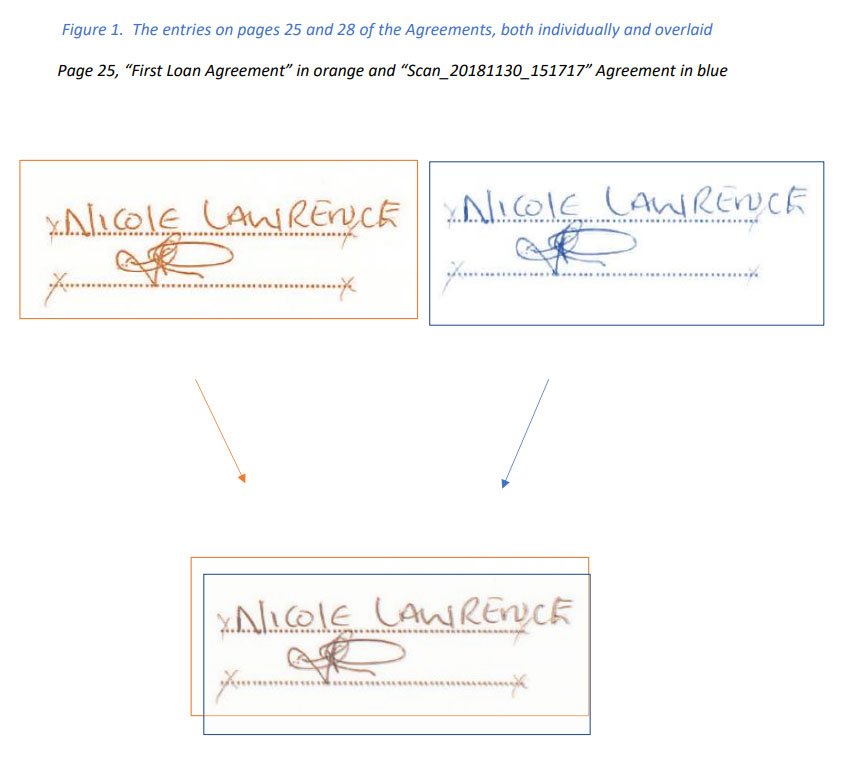
Signature overlay from the Keith Borer / Caramiello Expert Report: pages 25 and 28 of the two agreements overlaid. The signatures are pixel-identical — consistent with digital transplantation, inconsistent with two separate signing events. This evidence was never tested at trial. View full Expert Report ↗
Disclosure refused — then absence of proof used against the party denied it
The Applicants allege that disclosure of the documents essential to testing the fraud case — the native digital files, metadata, execution file, Setfords solicitors' completion file, Berlad Graham attendance notes, and delivery and escrow records — was refused, and the resulting inability to prove provenance was then treated as evidence that the fraud case was unwinnable.
The Applicants were required in substance to prove facts that lay within the exclusive possession of HNW and its solicitors: the creation pathway, the execution materials, and the native provenance documents. When they could not do so without disclosure, that inability was used against them as though it showed weakness in their case, rather than the effect of concealment. The Applicants say that is a fundamental inversion of the relationship between disclosure obligation and proof burden: you cannot refuse the means of proof and then rely on the absence of proof as your answer.
The Applicants specifically note that HNW's Reply reserved the right to rely on expert handwriting evidence under CPR 35.4 while simultaneously arguing the fraud case was hopeless and disclosure unnecessary. That internal contradiction — needing an expert if the case were tried, but claiming it was unarguable — was not resolved by the Court.
Hearing inequality — five hours for the corporate claimant, one hour for the unrepresented Black litigant
The Applicants allege that the hearing at which the Defence and Counterclaim was struck out was conducted on a structurally unequal footing: HNW, represented by lawyers, was afforded approximately five hours to advance its case on complex fraud, execution, provenance, delivery and enforceability issues; Ms Lawrence, as a litigant in person, was afforded approximately one hour to respond to the same issues.
The Applicants say that disparity materially affected the ability of an unrepresented party to present a complex document-sensitive fraud case, and that in a case of this kind — where the issues included document creation, signature provenance, escrow delivery, changing deed narratives, the £300,000 inducement, blocked restitution and conflicted receivership — one hour was not a fair equivalent of five. The Defence and Counterclaim was then struck out on that unequal footing.
The Applicants also note that Ms Lawrence was simultaneously managing overlapping proceedings across multiple courts and tribunals — county court possession proceedings, First-tier Tribunal matters, Upper Tribunal matters and Court of Appeal proceedings — while illegal evictions and property interference were continuing on the ground. They say the hearing inequality cannot be separated from that context of multi-forum fragmentation which, on their case, was itself a product of HNW's enforcement strategy.
Ratification inferred without trial — blocked restitution and the "no exit" structure ignored
The Applicants allege that HHJ Lenon KC inferred ratification of the enlarged £1.6 million transaction from later conduct, without directing trial of the ratification question, and without examining whether the conditions for free and informed ratification could possibly have been met given the undisputed facts: the £300,000 development tranche was never advanced; the £65,000 payment was retained; restitution was blocked; the structure became commercially non-exitable; and later conduct occurred under pressure and without realistic alternative.
Free and informed ratification requires knowledge of the act to be ratified and a free choice to adopt it. The Applicants say that each of those conditions was absent. The £300,000 — the consideration said to justify the enlarged security — was never advanced within the original nine-month term. The £65,000 payment evidenced completion of the earlier £900,000 transaction, not adoption of the enlarged one. The Applicants sought to unwind the enlarged position; restitution was blocked. Any later conduct therefore occurred under pressure and in the absence of any realistic alternative. That cannot in law constitute ratification.
Conflicted receiver authority assumed — FSMA regulatory framework ignored
The Applicants allege that receiver authority and enforcement were assumed to be lawful without any determination of: (a) the validity of the underlying charge on which receiver authority depended; (b) the undisclosed marital relationship between Charles Ranby-Gorwood (the appointed LPA receiver) and Rachel Ranby-Gorwood (HNW's Portfolio Manager); or (c) whether the lending and enforcement activity engaged the Financial Services and Markets Act 2000 and, if so, whether HNW had the required regulatory permissions.
On the Applicants' case, the receiver's appointment depended on a valid charge. If the charge was void — because the deed was a forgery, or because escrow release was never proved — the receiver's appointment fell with it. Even if the charge were valid, the undisclosed conflict between the receiver and HNW's Portfolio Manager required scrutiny before enforcement acts could be treated as neutral and regular. Neither point was examined. The FSMA point — which, if established, would make the facility unenforceable as an illegal regulated activity — was not treated as a threshold issue at all.
Counterclaim struck out on false platform — downstream contamination
The Applicants allege that the counterclaim — including claims for unlawful eviction, property damage, harassment, blocked restitution, spoliation and consequential loss — was struck out on the same false platform as the Defence, and that the resulting untried premises were then exported across multiple courts, tribunals and enforcement forums as though they had been lawfully determined.
The counterclaim depended on the validity and legal effect of the deed and the authority said to flow from it. Those gateway issues were never tried. The counterclaim could not safely be dismissed without first determining them. Once struck out, the Applicants lost the ability to litigate those consequences. The Applicants describe this as self-validating error propagation: the disputed deed led to concealment of provenance; concealment led to the fraud case being shut out; the strike-out was then cited as proof that no fraud existed; that supposed proof was acted on across later forums; and the later enforcement outcomes were in turn treated as proof that the original order must have been correct.
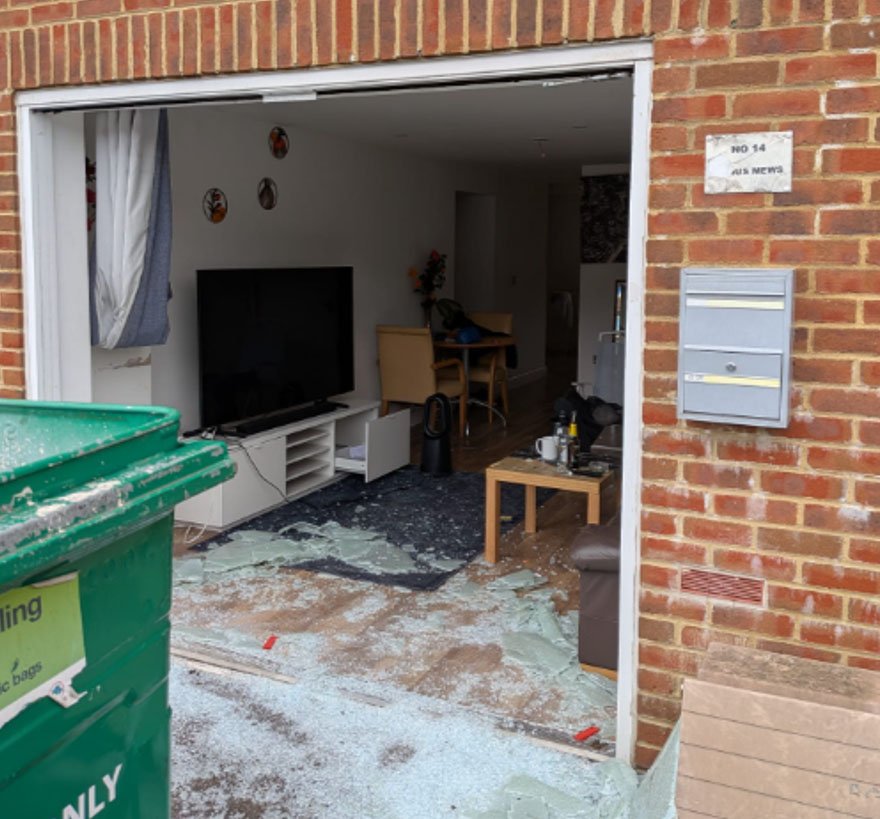
Photograph exhibited in proceedings: boarding of an occupied residential property — alleged to have occurred without a court order, warrant or identified statutory power. The counterclaim in respect of these events was struck out before they were tried.
The BAME dimension — safeguards that apparently do not protect Black litigants in the same way
The Applicants allege that the pattern of procedural treatment across these proceedings discloses an effects-based inequality: the safeguards that exist on paper to protect all litigants from fraud, forgery, document manipulation, unlawful eviction and summary disposal of fraud cases were systematically removed for a Black family in person, while a represented corporate lender was afforded reformulation, inference, assumption and enforcement at every evidential weakness.
The Applicants do not allege subjective racial motive. They rely on objective, effects-based unequal treatment. The question they raise is practical and public: a fair-minded and informed observer would ask why a Black family's allegation of property fraud — supported by independent forensic expert evidence at conclusive level, a stamped receipt contradicting the lender's case, a litigant in person denied equal hearing time, and a corporate lender permitted to shift its case after commencement — was treated as a hopeless strike-out candidate, while the corporate lender's shifting and contradictory narrative was treated as capable of salvation at every turn.
Ms Lawrence received: fraud case struck out on paper; disclosure refused; independent expert evidence dismissed without counter-evidence or cross-examination; one hour at the hearing; counterclaim extinguished; 20+ alleged illegal evictions without interim protection; property portfolio lost.
The Applicants' case is that this asymmetry engages Article 14 ECHR read with Article 6 and Article 1 Protocol 1. The same safeguards that protect corporate litigants from having their positions closed without trial were not applied to protect a Black family's fraud and forgery case.
The Applicants submit that the nine departures above are not isolated errors. They form a coherent mechanism: the forgery question was bypassed by reformulation; the fraud case was struck out without disclosure, expert testing or cross-examination; the proof-route was removed by refusal of disclosure; the resulting absence of proof was used against the party denied the means of proof; hearing time was allocated on structurally unequal terms; ratification was inferred from conduct that could not in law constitute ratification; receiver authority and FSMA enforceability were assumed rather than tested; the counterclaim was extinguished on the same false platform; and the resulting untried premises were exported across courts and tribunals as though they had been lawfully determined.
The Applicants say that sequence converted the appearance of civil justice into its substance: a Black family lost their property portfolio, their home, and their counterclaim to a process that produced the form of judicial determination without its content. The questions raised for BAME communities are not abstract: why should they trust orders that carry judicial form but lack lawful adjudicative substance, and why are they not entitled in practice to the same protection from fraud, forgery and procedural unfairness that civil law promises on paper?