Important: All content on this page is drawn from filed court documents. These are allegations by the Applicants. They do not constitute findings of misconduct. Lady Justice Andrews is entitled to the presumption of having acted in good faith.
CPR 55.8 — Possession without trial of genuinely disputed anterior issues
The Applicants allege that possession and enforcement consequences were allowed to proceed and harden without any lawful trial of the anterior issues — deed validity, escrow release, delivery, receiver authority and beneficiary occupation — that CPR 55.8 required to be tested before a genuinely disputed possession claim could proceed to enforcement.
CPR 55.8 requires that where a possession claim is genuinely disputed on grounds that
The process took the benefit of both positions: no trial when safeguards were requested, but finality and possession consequences when enforcement was pursued. That is inconsistent with CPR 55.8 and the principle that possession consequences cannot safely rest on untried anterior issues — BGSkeleton §§81–86.
Descent into the arena — Inventing the completion chronology
The Applicants allege that Andrews LJ (together with Nugee LJ) did not merely adopt HNW's pleaded case — she supplied a factual premise that HNW had never advanced and that was directly contradicted by HNW's own verified pleading and the stamped documentary receipt.
HNW's pleaded and verified case was that the legal charges were held on 14 November 2018. The documentary record and a stamped receipt confirmed escrow transmission. The Court's judgment recorded that the charges were provided "directly after completion" — a chronology that HNW had not advanced and that the Applicants say was invented by the Court. That single invented phrase supplied the missing factual bridge that avoided the escrow problem entirely: if the charges moved "directly after completion" there is no gap, no held instrument, no escrow-release step to explain.
The Applicants exhibit a stamped receipt confirming the escrow holding. The invented "directly after completion" chronology is irreconcilable with that receipt and with HNW's own pleaded case. The Applicants say that is not neutral fact-finding — it is descent into the arena, supplying a missing proof-route for the represented claimant while the unrepresented Black family lost property.

Stamped receipt exhibited in proceedings: legal charges held on 14 November 2018 — directly contradicting the invented "directly after completion" chronology. Filed as Greene v HNW Précis.
📄 Filed expert report and chronology documentation ↗TOLATA 1996 — Beneficiary rights treated as forfeited through non-joinder
The Applicants allege that Andrews LJ treated the beneficial interest of Mr Greene as either derivative of Ms Lawrence's struck-out defence or forfeited by reason of his decision not to join the lower-court proceedings — without ever determining his distinct statutory and equitable rights.
The Court's conclusion was that Mr Greene's interests were "fully aligned" with Ms Lawrence's and that he had "missed his opportunity." The Applicants say this converts non-joinder into a substantive extinguishment of rights that had never been adjudicated: his TOLATA occupation rights, his overriding interest as an actual occupier under LRA 2002 Schedule 3 paragraph 2, his personal eviction claims, his beneficial interest in trust property, and the welfare of minor children in occupation.
Mercury principle, CPR 32.19, CPR 35 and fraud — "Not persuaded of fraud" without any of the tools needed to prove it
The Applicants allege that Andrews LJ upheld the rejection of a fraud case — including independent expert evidence of document manipulation and signature copying — without disclosure of native files or metadata, without cross-examination, and without any trial of provenance. Independent forensic evidence from Keith Borer Consultants / Caramiello was treated as coming too late or as insufficient, despite never having been tested at a trial.
The Mercury Tax Group principle requires that where a document is alleged to be a composite — a signature page transplanted onto materially different terms — provenance must be proved. The Applicants say the Court allowed enforcement of a loan agreement alleged to be such a composite without requiring HNW to prove which instrument was signed, when, by whom, and on what terms. Disclosure of the execution trail, native files and metadata was refused. The Applicants say that made proof of fraud structurally impossible, and then used the resulting absence of proof against them.
CPR 32.19 places the burden of proving authenticity on the party relying on a document where its authenticity is challenged. The Applicants allege the Court inverted that burden: the Black family was required to disprove authenticity without the documents needed to do so.
CPR 35 requires that expert evidence on a disputed issue be fairly received and tested. The Applicants say the independent forensic evidence — showing that signatures across the two versions of the agreement were pixel-identical copies — was dismissed without the benefit of any expert cross-examination or counter-evidence. Andrews LJ stated she was "not persuaded of fraud." The Applicants say that is not an adjudication; it is premature finality imposed on an untried allegation while the route to proof was foreclosed.
The forensic evidence: Expert analysis showed the signatures on pages 25 and 28 of the two agreements were pixel-identical — not merely similar but copied. The images below are drawn from the filed expert report:
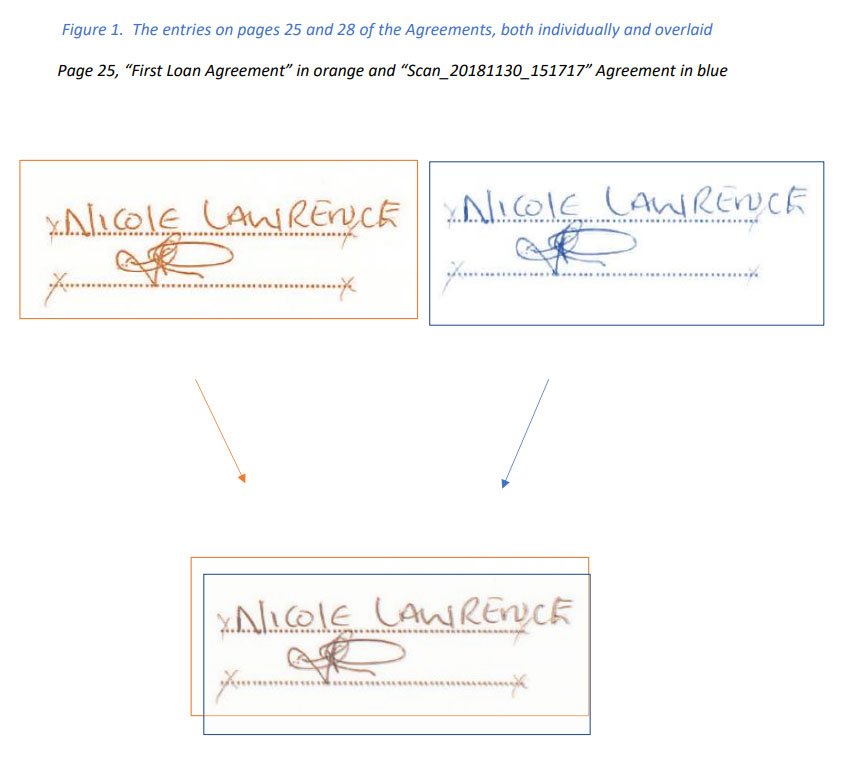
Figure 1 from the Keith Borer / Caramiello Expert Report — pages 25 and 28 of the two agreements overlaid. The signatures are pixel-identical, consistent with digital copying. Filed in these proceedings. View full Expert Report ↗
Beneficiaries "should not have a reasonable expectation the court would follow the law"
The Applicants allege that Andrews LJ effectively held that a beneficiary who trusted the court system to apply governing law and safeguards had no answer to the fact that he had not intervened separately in the lower proceedings.
The Applicants characterise this as a constitutionally troubling proposition. Mr Greene's case was that he had a reasonable expectation that the lower court would test disputed documents, apply the required safeguards, determine anterior integrity issues, and adjudicate fairly. The Court treated that expectation as legally irrelevant — as no answer to procedural closure.
The Applicants argue the correct analysis is the reverse: non-joinder is a procedural fact; it cannot extinguish substantive statutory rights that have never been adjudicated. If it could, every beneficiary, occupier or evidence-holder would be forced to intervene defensively in every claim affecting trust property — an unworkable and unjust principle that would strip TOLATA of any practical effect for those who are not themselves the named defendant.
"Difficult to see the harm" — Refusing protection against alleged illegal evictions
The Applicants allege that Andrews LJ refused interim protective relief against continuing illegal evictions, board-ups, smashed windows, displacement and harassment, stating that it was "difficult to see the harm." Since that refusal, the Applicants say the harm escalated.
Ms Lawrence and Mr Greene had placed before the Court evidence of repeated forced entries without any court order, the smashing of windows, boarding of properties, displacement of occupiers including children, removal of possessions and documents, and continued harassment. No court order, warrant, notice or identified statutory power was produced for those entries. The Protection from Eviction Act 1977 makes residential eviction without court order a criminal offence. The Applicants say the Court's refusal did not merely fail to protect: it treated continuing, documented, photographed harm as legally invisible — and thereby enabled its continuation.
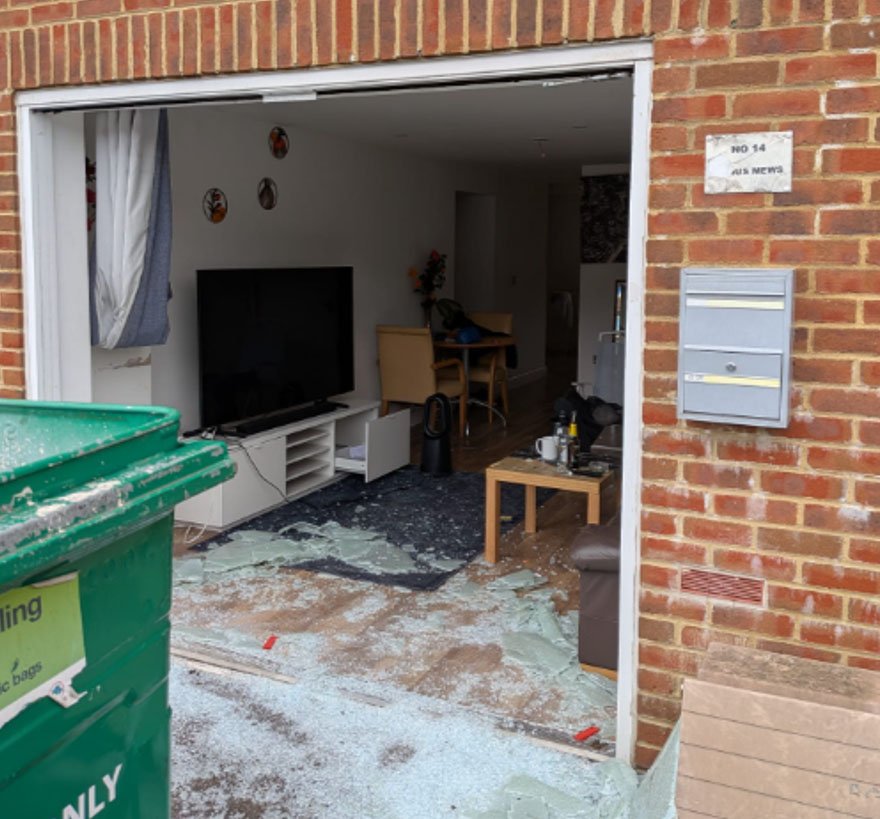
Photograph exhibited in proceedings: smashed windows and forced entry — alleged to have occurred without any court order or identified statutory power.
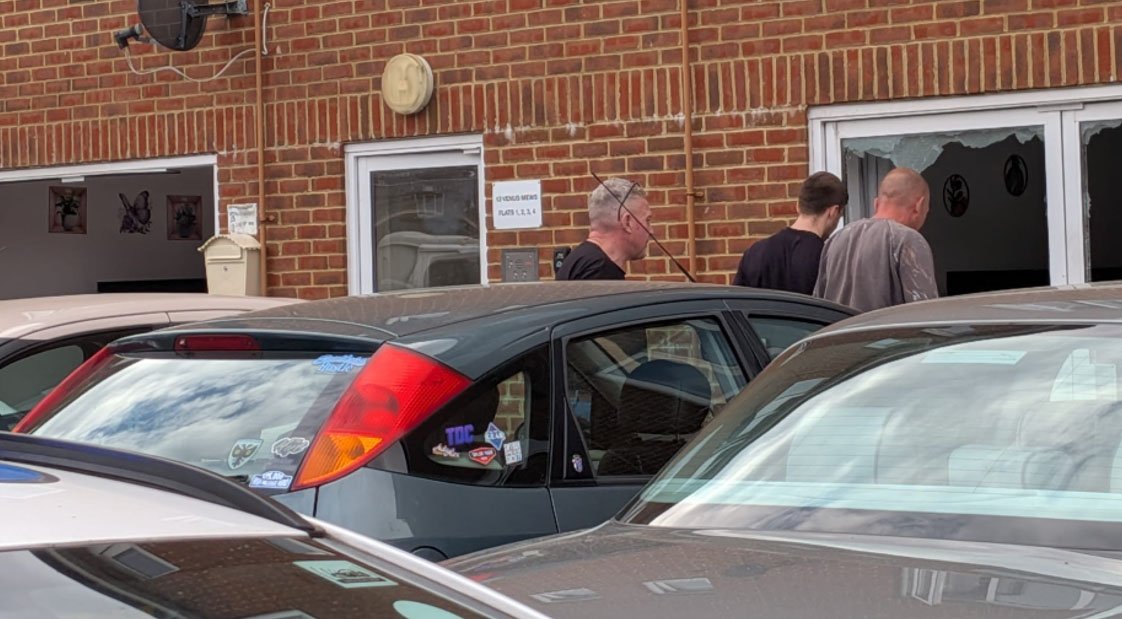
Further damage photograph: boarding of occupied premises. Part of a continuing pattern from January 2021 to April 2026.

Enforcement officers attending a property without identified court order or writ — filed as evidence of unlawful eviction.
The contract-cure / deed-enforcement contradiction — An irreconcilable internal inconsistency
The Applicants allege that Andrews LJ allowed HNW to obtain the benefit of two mutually exclusive legal positions simultaneously: the instrument was treated as a contract (to avoid deed-formality, Mercury, execution and delivery objections) while deed-based statutory enforcement powers — LPA receivership, legal-charge priority, possession — were simultaneously preserved.
The contradiction is structural. Under the Law of Property Act 1925 ss.101 and 109, statutory mortgagee powers and LPA receiver authority depend on the existence of a valid legal mortgage created by deed. If the instrument is only a contract, those powers do not arise. If those powers are to be exercised, the deed must be valid — which requires its execution, delivery, escrow release and provenance to be proved. The Court allowed HNW to avoid those requirements by contract-cure reasoning while simultaneously retaining enforcement consequences that only a valid deed can generate.
Case closed without any document testing
The Applicants allege that the entirety of the contested documentary record — the loan agreement, the legal charges, the execution trail, the escrow documents, the completion records, the receiver-authority instruments, and the Land Registry materials — was closed without a single document being tested in the way that ordinary civil justice requires.
The following were never produced, ordered or examined before the case was treated as finally determined:
- Native digital files and metadata for the loan agreement and legal charges
- Execution trail documents (who signed, when, in whose presence, by what process)
- Escrow-release documents (the lawful act by which held instruments were released for the materially different £1.6 million terms)
- Setfords solicitors' file — the only contemporaneous record of the signing event
- Berlad Graham attendance notes
- Receiver-authority instruments and appointment records
- Land Registry application files and communications
No witness was cross-examined on document creation, transmission, signing, witnessing, attestation, release, delivery, reliance or enforcement. The expert forensic evidence was not received and tested at a trial before fraud was treated as closed. Ms Lawrence's evidence, her occupation, her beneficial interest, her eviction evidence, her source-of-funds evidence, and her development expenditure were not tested before findings affecting her were treated as settled.
The appellate court's role — Adoption and extension rather than review
The Applicants allege that Andrews LJ did not perform the review function that an appellate court is required to perform. Instead of scrutinising the lower court's process, the Court adopted and extended its premises — supplying new dispositive conclusions that went beyond even what HNW had advanced — and thereby became complicit in the same process failures that were the subject of the appeal.
The proper appellate function under CPR 52.21 is to determine whether the decision under appeal was wrong or unjust because of a serious procedural or other irregularity. Where the challenge is to process integrity — to the fairness of the platform on which a decision was reached — the appellate court must examine whether the required safeguards operated. The Applicants allege the Court instead:
- Adopted Lenon KC's reformulated chronology and treated it as settled
- Supplied new premises absent from HNW's pleaded case ("directly after completion," "monies undoubtedly advanced," "adoption," "ratification," "no fraud," "no harm")
- Treated non-determinations at first instance as determinations
- Refused protective relief whose purpose was to prevent the hardening of precisely the consequences under appeal
- Maintained factual errors after those errors were specifically documented and placed before the Court
Intercepting a CPR 52.30 application contrary to UCP v Nectrus
The Applicants allege that Andrews LJ determined, or participated in refusing, a CPR 52.30 application — an application specifically challenging the integrity of the constitution of which she was part — contrary to the principle established in UCP Plc v Nectrus Ltd that a process-integrity challenge should not be determined by the same constitution whose reasoning is directly impugned.
CPR 52.30 exists to reopen appeals in exceptional circumstances where it is necessary to avoid real injustice. Its purpose is integrity review. The Applicants had placed before the Court specific, documented factual errors in the chronology and specific, documented legal departures. The application to reopen was placed before — and refused by — the same constitution that had reached the impugned conclusions. The Applicants say that is a structural breach of the rule in UCP v Nectrus: the corrective mechanism exists in form but was disabled in substance when invoked by these Applicants.
Civil Restraint Order threat — Constitutional concern
The Applicants allege that Andrews LJ raised the threat of a Civil Restraint Order in circumstances described as constitutionally serious: the substance has never been tried, the documents have never been tested, disclosure has been refused, the expert evidence was never put to trial, and the chronology relied upon by the Court was itself challenged as invented.
A CRO may label applications as "totally without merit." The Applicants argue that that label cannot make an application without merit where the substance has never been adjudicated. To raise a CRO threat in those circumstances, they say, converts virtual exclusion into actual exclusion: first the litigant is denied trial, then denied disclosure, then denied correction of factual error, and finally threatened with restraint for persisting in asking the court to apply the law.
The Applicants submit that the eleven departures above are not isolated errors. They form a coherent mechanism: a corporate claimant's case was reformulated and bridged by judicial reasoning; a Black family's fraud case was rejected without the tools needed to prove it; property was lost without trial; illegal evictions were minimised; beneficial interests were extinguished by procedural closure; a CPR 52.30 application was refused by the constitution under challenge; and a CRO was threatened to prevent further correction. That sequence, they say, converts civil justice into a one-way instrument. It is the subject of a formal open letter to the Lord Chancellor dated May 2026.
The unanswered question is how that sequence can be reconciled with fair and neutral adjudication. If fraud was rejected without disclosure, metadata, native files, expert testing or cross-examination, and independent expert evidence ignored; if escrow delivery was invented by the judges, without a release act; if document provenance was never tested; if evidence destruction was not investigated; and if courts and tribunals then treated those non-determinations as determinations, the concern is not merely error. It is institutional failure in operation. On the Applicants’ case, the proof-routes were removed, the legal tests were inverted, the document-testing route was withheld, and the resulting evidential gap was used to close the case. That does not resemble a neutral referee deciding a proved dispute. It resembles a manufactured end: the appearance of being heard converted into actual exclusion. The public question for BAME communities is stark: why should they trust orders that carry judicial form but lack lawful adjudicative substance, and why are they not entitled in practice to the same protection from fraud, forgery, unlawful eviction, proof destruction and procedural unfairness that the law promises on paper?